

In a world where distractions have become the currency of attention, productivity is no longer a matter of willpower—but of strategy. In the age of digital noise, true efficiency doesn’t come from working longer, but from cultivating smarter habits. If you feel like your days are slipping through your fingers, these ten tips can help you regain control of your time, energy, and focus.
1. Start Your Day with a Clear Intention
“If you don’t know where you’re going, any road will take you there.”
— Lewis Carroll
The way we begin our day sets the tone for everything that follows. When we dive straight into chaos—emails, notifications, messages, social media—we lose control of our time. We shift into reactive mode, chasing tasks without direction or fulfillment. The day passes, and we feel like we’ve accomplished nothing.
On the other hand, people who start their day intentionally have clearer priorities, greater time ownership, and a calmer mindset. They don’t try to do everything—they focus on what matters most.
What does this look like in practice?
Micro-planning your morning (5–10 minutes):
Sit down with a cup of coffee or tea and a notebook (or an app like Todoist, Notion, or just plain paper), and ask yourself these three questions:
- What absolutely must get done today? (Top 1–3 tasks)
- How do I want to feel while working? (Focused, calm, present…)
- What can I eliminate or delegate?
Example:
Instead of listing 12 to-do items, highlight 2 key tasks:
“Write the first draft of the report + schedule the team meeting.”
Everything else is a bonus—these two are the priority.
2. Assign a “Theme” to Each Day
Themed days help streamline your focus. For instance:
- Monday: Planning & communication
- Tuesday & Wednesday: Creative work / deep focus
- Thursday: Meetings & review
- Friday: Wrap-up & reflection
This reduces cognitive clutter because you always know what kind of work belongs to which day.
3. Visualize a Successful Day
It may sound cliché, but mentally projecting your day truly works. Imagine yourself completing your tasks with ease, entering a flow state, and ending the day with a sense of accomplishment. It takes less than 60 seconds but shifts your entire mindset.
Bonus Tip – Use the “MIT” Method (Most Important Task)
Choose one task that absolutely matters most today. If you complete only this, your day is already a success.
This method also works great in teams—every morning, each team member shares their MIT.
2. The Pareto Principle (80/20): The Secret to Big Results with Less Effort
In a world overwhelmed by obligations, distractions, and endless to-do lists, the real question isn’t how much we work, but what we work on. This is where one of the most powerful productivity concepts comes into play — the Pareto Principle, also known as the 80/20 rule.
What does 80/20 really mean?
The principle was introduced by Italian economist Vilfredo Pareto, who observed in the late 19th century that 80% of Italy’s wealth was owned by just 20% of the population. While his research focused on economics, the rule has proven to be universally applicable: in nearly every area of life and work, a small portion of causes leads to the majority of outcomes.
For example, in business, it’s often true that 80% of revenue comes from 20% of clients, 80% of results come from 20% of tasks, and 80% of problems stem from 20% of sources. When applied to personal productivity, the Pareto Principle reveals a simple yet transformative truth: not everything we do contributes equally to our progress.
Focus on What Truly Makes a Difference
One major reason many people feel like they’re constantly working but never achieving enough is because they spend too much time on low-impact activities. They react to what’s urgent but ignore what’s important. We get caught up in small tasks — checking emails every 10 minutes, perfecting presentations, adjusting to-do lists — instead of focusing on the few things that actually move the needle.
Applying the 80/20 rule means consciously identifying the few activities that generate the most value — and making them a priority. These are the tasks that create real progress, whether it’s deep creative work, decision-making, direct client communication, or strategic planning.
How to Identify Your “Vital 20%”
The first step is honest reflection. Look back at your past week. Which tasks truly made a difference? What led to concrete results — a new deal, a completed project, progress in learning, or better collaboration? Compare this to the tasks you spent the most time on, but that didn’t produce visible progress.
Then, ask yourself a simple yet powerful question every morning:
Which two or three actions today will move me closest to my goals?
When this becomes a daily habit, your to-do list stops being endless — it becomes focused. Shorter, but with tasks that matter.
Cut the Nois
Just as important as knowing what matters is consciously eliminating what doesn’t. This doesn’t mean neglecting responsibilities, but setting clear boundaries: through delegation, automation, or simply saying no. Every unnecessary task you remove creates space for what truly matters.
Time is a limited resource — and what we give attention to, we feed.
The 80/20 principle reminds us that we don’t need to do everything or be busy from morning till night. We just need to do the right things.
3. The Pomodoro Technique: A Work Rhythm That Boosts Focus and Productivity
Named after a tomato-shaped kitchen timer (pomodoro means tomato in Italian), this technique was developed by Francesco Cirillo in the 1980s. The concept is incredibly simple:
You work for 25 minutes on a single task with full focus, followed by a 5-minute break. After completing four cycles, you take a longer break of 15 to 30 minutes.
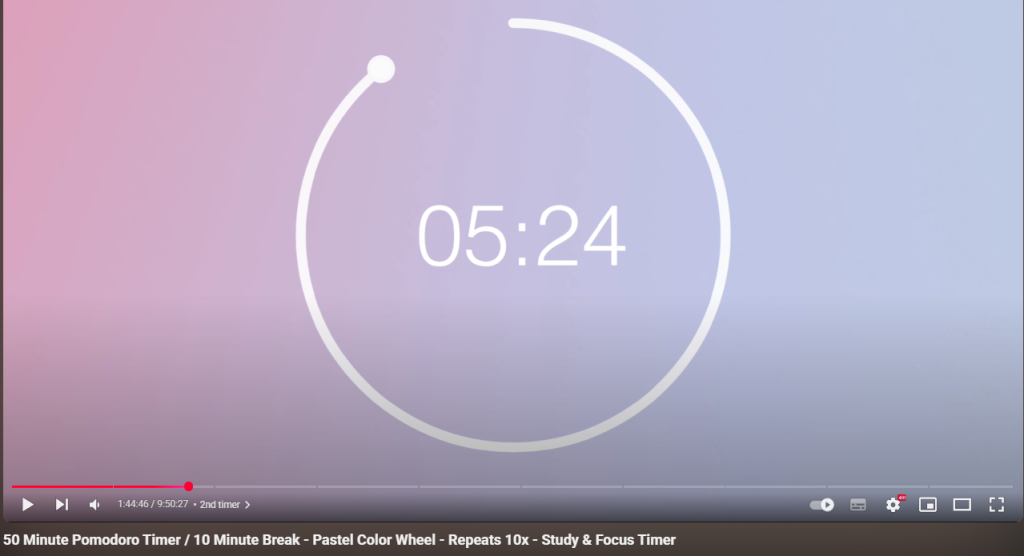
There are many clips on youtube with this pomodoro technique
You can even find numerous Pomodoro-timer videos on YouTube to help guide your sessions.
This structure aligns with the brain’s natural concentration rhythm, allowing it to rest at the right time — preventing burnout. Instead of pushing through like a marathon, you’re working in sprints — a far more sustainable energy model.
Why Does This Method Work So Well?
There are several reasons why the Pomodoro Technique has become a global favorite, especially among people working in environments full of distractions:
✅ Clear boundaries of focus – Knowing you’re only committing to 25 minutes makes it psychologically easier to get started. “Just 25 minutes” feels lighter than “I have to work for 3 hours.”
✅ Less multitasking – Pomodoro forces you to choose one task and stick with it. This significantly reduces mental fragmentation.
✅ Discipline training – The regular breaks reduce mental fatigue, while the structured rhythm builds consistency over time.
✅ Productivity tracking – You can measure progress by counting completed Pomodoros, which is motivating and concrete.
What Does an Ideal Work Block Look Like?
1. Preparation: Choose a specific task. Eliminate distractions — close your email, mute your phone, and turn off notifications.
2. Set the timer: Use a physical timer, or an app like Focus To-Do, TomatoTimer, Forest, or even a simple stopwatch.
3. Work for 25 minutes: Fully focused, no interruptions. If a thought or distraction pops up, jot it down quickly and return to your task.
4. Take a 5-minute break: Stand up, stretch, drink some water — resist the urge to check your phone. The goal is to give your brain a true break.
5. Repeat: After four Pomodoros, take a longer break (15–30 minutes) to recharge.
Adapting It to Your Rhythm
While the classic Pomodoro is 25/5, it’s not a rigid rule. Some people prefer 50/10 or even 90-minute deep work sessions. What matters is not the numbers, but the principle: focused work followed by a mandatory break.
It’s also important to know when not to use Pomodoro. If you’re in a state of flow — deep, effortless focus — don’t feel the need to stop just because the timer goes off. Pomodoro isn’t a cage, it’s a framework to help you enter that flow state.
Mental Freshness Matter
Your brain, like a muscle, has limits. Pushing it for hours without breaks leads to diminishing returns.
Instead of quality, you get quantity with little impact.
The Pomodoro approach helps you work less, but better. It keeps your mind sharp and reduces both physical and mental exhaustion — creating sustainable productivity for the long haul.
4. Eliminating Distractions: How to Protect Your Focus in the Age of Constant Connectivity
In today’s digital world, attention has become the most valuable resource — and simultaneously, the most threatened. Our daily lives are flooded with notifications, messages, ads, and endless streams of content, all demanding that we look, react, and engage. In such an environment, one of the key prerequisites for productivity is no longer just knowing what to do, but knowing how to defend your focus from everything trying to steal it.
Attention Is the Currency of Productivity
If you don’t control your focus, it will be spent on what others want — not what you choose. Every time you check your phone while working, glance at an email in the middle of a task, or open social media “just for a second,” you enter a cycle of disrupted thought. It takes anywhere between 10 to 20 minutes to regain deep concentration after a single interruption — and we often experience dozens of them per hour.
That’s why eliminating distractions isn’t a luxury — it’s the foundation of efficient work. Without it, even the best productivity techniques will fail to deliver results.
Digital Hygiene: A Daily Mental Discipline
Digital hygiene is a set of intentional habits and strategies that protect your mental clarity and prevent digital chaos from dictating your day. Key components include:
✅ Turn Off Non-Urgent Notifications
Most apps are designed to constantly grab your attention — new messages, likes, updates. Ask yourself: Do I really need to know this immediately?
Disable notifications for social media, news apps, games, and anything that interrupts without adding real value.
✅ One Channel, One Time
Don’t check emails or messages randomly throughout the day. Instead, designate 2–3 specific times to check and respond intentionally. The rest of the time is for uninterrupted work.
✅ A Digital Diet
Just like you’re mindful of what you eat, be mindful of what you feed your brain. If your first action in the morning is scrolling through TikTok or Instagram, your focus is already scattered.
Start your day without screens — or at least with something that fuels your mind, not drains it.
✅ Create Focus Zones
Develop rituals that signal to your brain it’s time for deep work. This could be a dedicated workspace, putting on noise-canceling headphones, or using apps that block social media (such as Cold Turkey, Freedom, or Forest).
✅ Physically Remove Your Phone
When deep focus is needed, place your phone out of sight. Even with the screen off, its mere presence subconsciously reminds your brain of a world waiting for attention.
Mental Silence and the Power of Empty Space

In moments when we’re not stimulated — simply walking, staring out the window, or doing “nothing” — our brains enter what neuroscience calls the Default Mode Network.
This is where creative ideas emerge, insights form, and deeper understanding occurs. But to get there, we must stop constantly consuming information.
Digital hygiene doesn’t mean rejecting technology — it means using it consciously, rather than impulsively.
“If you want your mind to perform like a precision instrument — you must protect it as you would your most valuable tool.”
MALAMEDIJA
5. Prioritization: The Skill of Knowing What Truly Matters vs. What Just Feels Urgent
This is one of the most important — and most overlooked — aspects of productivity. You can’t do everything. So you have to decide: What really matters? What deserves your energy?
Urgent Doesn’t Mean Important
One of the clearest ways to understand this distinction comes from former U.S. President Dwight D. Eisenhower. His famous insight was later turned into the Eisenhower Matrix — a simple yet powerful decision-making tool:
- Important & Urgent → Do it now.
Crises, deadlines, problems that can’t wait. - Important but Not Urgent → Schedule it.
These are long-term contributors — learning, planning, strategy, prevention. - Urgent but Not Important → Delegate it.
Tasks that feel like a priority but don’t bring real value — other people’s requests, unnecessary meetings, distractions. - Neither Important Nor Urgent → Eliminate it.
Time-wasters, habits that drain energy, aimless activities.
Most people — especially when stressed — spend their time in the “urgent but not important” quadrant, solving other people’s problems instead of building their own progress.
How to Set the Right Priorities
Prioritizing isn’t just about saying, “This is important to me.”
It’s about making a conscious decision to limit your attention and energy to what genuinely moves you forward. Here’s how:
✅ Define Clear Goals
Without a clear goal, you can’t have clear priorities. Start with questions like:
What do I want to achieve this week? This month? This year?
Anything that doesn’t align with that becomes secondary.
✅ Use the Rule of Three
Every day, choose your top three tasks. Not ten. Not eight. Just three.
This forces you to focus on what truly matters and design your day around it.
✅ Spot Emotional Traps
Some things feel urgent just because they carry emotional pressure — fear of disappointing others, guilt, or a desire to “keep everything under control.” Learn to separate emotion from true importance.
✅ The “If Only One” Rule
When in doubt, ask yourself: If I could only finish one thing today, what should it be?
The answer is often your real priority.
Focus Doesn’t Mean Ignoring Everything Else
Setting priorities doesn’t mean ignoring other responsibilities — it means putting them in the right order.
When you know what truly matters, it becomes easier to say “no” — without guilt.
And more importantly, that “no” becomes a powerful “yes” to something greater:
Your clarity, your purpose, your energy.
6. Waking Up Early and Morning Routines: How the First Hour Shapes Your Entire Day
There’s a saying: “How you start your morning often determines how the rest of your day unfolds.”
And it’s true — morning is not just the time before work. It’s a mental platform, a chance to set the tone of the day with calm, intention, and clarity — before the world starts demanding your attention.
Waking up early and having a solid morning routine isn’t just a trend among successful people — it’s an invisible pillar of long-term productivity.
A Morning Without Chaos
Most people start their day in panic mode: they wake up late, grab their phone immediately, rush through breakfast, reply to emails while still in bed… and by 8:00 AM, they’re already drained.
The day runs them, not the other way around.
Let’s be clear — we’re not doing that anymore.
In contrast, waking up early gives you space. Time that is purely yours. No noise, no demands, no messages. Just calm, slow, intentional presence.
It’s in this space that strength is built — not just for the day, but for your entire rhythm of life.
What Does “Early” Really Mean?
“Early” doesn’t have to mean 4:30 AM like a soldier or some self-help millionaire.
It simply means: earlier than you need to.
Early enough to give yourself at least 30 to 60 minutes of uninterrupted personal time before the world starts calling.
It’s not about the clock — it’s about the peace and purpose that time brings.
What Makes a Great Morning Routine
An effective morning routine doesn’t have to be elaborate or rigid.
The goal isn’t to fill every minute — it’s to create space for mental clarity, physical activation, and emotional grounding.
Here are common elements found in powerful routines:
- Silence and Awareness – Meditation, deep breathing, quiet sitting, or prayer. Even a few minutes of stillness resets the mind.
- Writing – Journaling, gratitude lists, planning your day. Writing helps you clear mental clutter and gain focus.
- Movement – Light exercise, yoga, stretching, or a short walk. Physical activity activates your body and your brain.
- Learning or Reading – 10–20 minutes of quality content — books, articles, or podcasts — to feed your mind before the noise begins.
- Daily Planning – Reviewing tasks, setting priorities, and choosing your focus for the day.
You don’t need all of these. Even just two or three done consistently can have a powerful effect.
Morning Time as a Power Zone
Many successful people — from CEOs to artists — say their most important decisions, deepest thinking, and best ideas happen in the early morning hours.
Why? Because this part of the day is the least contaminated by the outside world.
It’s sacred — and it should be treated as such.
What If You’re Not a “Morning Person”?
That’s totally okay. You don’t need to become one overnight.
Try this instead:
- Go to bed 15 minutes earlier each night
- Wake up 15 minutes earlier each morning, and gradually increase that window
- Choose one small morning ritual that feels good — and repeat it daily, even if it’s just 10 minutes
The goal is simple:
You should control your day — not let the day control you.
7. Delegation and Trust: You Don’t Have to (and Shouldn’t) Do Everything Alone
One of the biggest long-term productivity blockers isn’t a lack of skill — it’s the belief that you have to do everything yourself. Whether it’s your job, daily responsibilities, or passion projects, one truth remains:
If you want to grow, you have to learn to share the load.
Why Delegation Is Essential
Many people avoid delegating out of fear — fear that things won’t be done “the right way,” that they’ll lose control, or that it will slow them down.
But in reality, trying to do everything yourself doesn’t speed things up — it suffocates progress.
When high-performing people manage massive workloads, it’s not because they work more hours than everyone else — it’s because they’re crystal clear on this:
What is their job, and what isn’t.
Trust Is the Foundation
Delegation isn’t just about offloading tasks — it’s an act of trust.
When you allow others to take responsibility, you don’t just free up time — you give them an opportunity to rise, contribute, and grow. It may not always be perfect, and that’s okay. Growth rarely is.
The most effective individuals and the strongest teams don’t run on control — they run on mutual trust.
Learning when to say “I don’t have to be the one to do this” is a sign of maturity, not weakness.
You Weren’t Meant to Carry It All Alone
Delegation matters in your personal life too.
You don’t need to lead every conversation, fix every issue, or obsess over every detail.
Letting others take part — whether at work or at home — doesn’t take away from your value. In fact, it gives you the space to return to who you truly are, not just who everyone needs you to be.
Of course, sometimes it’s not possible to delegate — and that’s okay.
But if there’s a task you can hand off — do it.
Not just to get it done, but to protect your energy for the things that truly need you.
8. One Task at a Time: Focus as a Superpower
In a world of speed, notifications, and constant interruptions, multitasking seems like a necessary skill.
But the truth is quite the opposite — multitasking slows us down, scatters our attention, and reduces the quality of everything we do.
Focusing on just one thing — and only that thing — has become a luxury, but also a powerful weapon for achieving meaningful results.
Fewer Tasks, More Presence
When you do one task without distractions, you enter a state known as flow — the zone of deep focus and full immersion.
Time disappears. Concentration increases. Tasks are completed faster and with better quality.
On the flip side, constantly switching between tasks drains mental energy, increases stress, and leaves you feeling like nothing is truly finished.
How to Practice “One Thing at a Time”
Start with small changes:
- Close unnecessary tabs on your computer
- Silence your notifications
- Set short time blocks (e.g. 25 minutes using the Pomodoro technique) where you do only one thing
Even just one or two hours of true focus per day is more valuable than an entire day spent in scattered effort.
It’s not about doing more — it’s about being fully present in what you’re doing.
“Success doesn’t come from how much you do, but from how fully present you are while doing it.”
— Robin Sharma
9. Technological Discipline: You Use Technology – Not the Other Way Around
The digital world is filled with tools that can improve our work, but also countless traps that can trap us in a spiral of scattered attention. Notifications, social media, messages, and emails constantly compete for our focus. The essence of productivity today is not about having the best app – it’s about knowing when and how to use technology, and when to turn it off.
Conscious Use, Not Impulsive
Set rules — designated time blocks for checking emails, turning off notifications while working, and taking digital breaks throughout the day.
There’s no need to respond immediately. The world won’t stop, but your concentration will.
Use Tools That Support You
Organizational apps, focus timers, and calendars for structuring your day are all helpful tools. But don’t let your day be dictated by apps — you decide when and how you work.
Digital Space as a Tool, Not an Escape
Technological discipline doesn’t mean deprivation, but conscious use. In a world screaming for our attention, the power lies in knowing when to say “no” to the algorithm and “yes” to yourself.
“Technology should serve you, not become your master.”
— Tim Ferriss
10. Relaxation and Regeneration: Productivity Is Not a Sprint, But a Marathon
In a culture of “always busy,” rest is often perceived as weakness, luxury, or a waste of time. How many times have we heard or even said, “I don’t have time, I have to work, I have to do this, I have to do that”? No, you don’t have to do anything! Slow down, take a pause sometimes! The most productive people in the world know when to take a break and “recharge their batteries.”
A Break Is Not a Disruption – It’s an Investment
When you rest, you’re not avoiding work – you’re replenishing your capacity for the next step. A tired mind makes poor decisions, loses focus, and makes mistakes. Even the most creative minds – from scientists to artists – take time for withdrawal, walks, silence, or physical activity because they know that ideas don’t arise in chaos, but in peace.
Learn to Pause
Incorporate short breaks into your day. Create an evening ritual – a moment when you close your laptop and mentally turn off work mode. Respect weekends, days off, and sleep. Nothing drains your energy more than constant activity without breathing.
Rest doesn’t mean passivity. It’s an active nurturing of your capacity to give your best – when it really matters.
So, in the sea of obligations, work, and everything else, DON’T FORGET ABOUT YOURSELF!
It’s extremely important to remember this… focus on physical and mental health first, and then everything else will fall into place. When we are healthy, everything else becomes easier… think about it! A short break and a “reset” are incredibly powerful.
“Successful people don’t work more – they know when to stop, recharge, and come back stronger.”
— Arianna Huffington
Dear friends, we have come to the end of this article about tips for better productivity. We hope it will be helpful to you.
If you enjoyed it, share it on your social media and check out our other articles. Also, follow us on YouTube, where we regularly release documentaries on various topics. You can visit the channel here.
Thanks a lot,
MALAMEDIJA TEAM


