
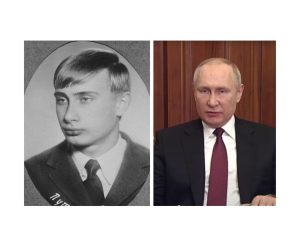
Vladimir Putin, the current President of the Russian Federation, is one of the most influential figures in modern politics. His ascent to power marked a turning point in Russia’s political and social landscape. Before becoming president, Putin had extensive experience in various fields and played a significant role in Russian political life. This is the complete biography of Vladimir Putin, President of Russia and one of the most powerful men of our time.
Early Life: Born in Leningrad
Vladimir Vladimirovich Putin was born on October 7, 1952, in the then Leningrad—now known as Saint Petersburg—one of the most prominent and significant Russian metropolises. He was born into a modest working-class family: his father, Vladimir Spiridonovich Putin, was a factory foreman, while his mother, Maria Ivanovna, worked as a supervisor in a workers’ cafeteria.
Putin’s early years, as the saying goes, were marked by modesty and the hardships of Soviet society. A child in the post-war USSR, Putin, by his later accounts, grew up surrounded by poverty and a struggle for basic survival. Nevertheless, despite these initial challenges, he demonstrated remarkable resourcefulness and a strong desire to succeed. His early life story reflects the broader picture of Soviet society at the time—a society shaped by the hardships of the communist regime, but also one that offered opportunities, which Putin, even as a twelve-year-old, seized to gain an education and develop traits that would later prove crucial to his political rise.
Education and Entry into the KGB
In the 1970s, Putin enrolled in the Law Faculty at Leningrad State University, graduating in 1975. During this period, he was already gradually orienting himself toward a career in intelligence, which was a common and prestigious path for many young people in the Soviet Union. Given his background, it was not difficult for Putin to join the KGB, the most powerful Soviet intelligence agency at the time, which he regarded as a prestigious institution. (This very organization continues to provide him with security today—how they protect him can be seen here.)
In 1975, shortly after graduating, Putin became an officer in the KGB, marking the beginning of his career in intelligence. He became part of the Soviet espionage apparatus, operating both domestically and abroad, helping maintain the Soviet Union’s high level of security and influence. In 1985, he was assigned to Dresden, in what was then East Germany, where he served as the head of the KGB for the region. This period in Dresden was pivotal to his career, as it allowed him to gain insight into the dynamics of international relations, build connections with Western intelligence agencies, and understand the internal struggles within the Soviet Union.
Politics and Entry into Power
Upon returning to Saint Petersburg in the 1990s, Putin quickly established a connection with Anatoly Sobchak, then the mayor of the city. This meeting proved to be pivotal for his entry into politics. Sobchak, an influential politician and mentor, appointed Putin as deputy mayor. In that role, Putin was responsible for the city’s economic affairs and legal security, but increasingly found himself within circles of political influence. During this period, he began building a network of contacts across business, politics, and state institutions—connections that would later prove essential for his rise to power.
Putin also started to gain a reputation as a skilled organizer and administrative expert, capable of dealing even with the criminal underworld that dominated Russia during that turbulent era.
Rise to the Presidency
By the time Boris Yeltsin, then-President of Russia, decided to withdraw from the political scene in 1999, Putin was already in a key position that would determine his political future. Yeltsin chose Putin as his successor, believing he was better equipped to manage a Russia plagued by economic hardship and political instability. In 1999, Putin was appointed Prime Minister of Russia, and just a few months later—following Yeltsin’s sudden resignation—he assumed the role of President on December 31, 1999.
From that moment on, Putin began reshaping Russia’s political landscape. As the first president of the new millennium, he laid the foundation for the centralization of power—a defining feature of his leadership throughout all his presidential terms. He quickly earned a reputation as a leader with tight control over domestic affairs, confronting challenges ranging from internal unrest to protest movements, all while working to reinforce Russia’s authoritarian political model.
First Presidential Term: 2000–2004
When Vladimir Putin became President of Russia in 2000, he faced numerous challenges. The country was still deeply affected by the aftermath of the Soviet Union’s collapse, economic instability, rampant inflation, and the ongoing war in Chechnya. Russia was in a period of political and economic transition, and Putin entered the scene with a clear mission to restore stability and state strength.
One of his first major moves was to pacify Chechnya. During his first term, Putin opted to use military force to suppress Chechen separatists and establish control over the volatile region. This approach drew international criticism for human rights violations, but within Russia, it solidified Putin’s image as a leader willing to take decisive action to defend national interests.
Economic reform and stabilization were key goals during his first term. With high oil prices and increasing revenues from energy exports, Putin steered Russia toward economic recovery. His administration implemented tax reforms that simplified the system, reduced tax rates, and supported the growth of Russian businesses. Additionally, he introduced a stable economic policy that helped reduce inflation and spurred growth in gross domestic product (GDP). Putin became a symbol of economic stability and was viewed by many around the world as the leader who restored Russia’s dignity on the global stage.
At the same time, Putin began strengthening and centralizing state institutions. Power was increasingly consolidated, and many oligarchs who had gained excessive influence during the chaotic “wild capitalism” of the 1990s were pressured to withdraw from political life. Putin gradually took control over the media and political institutions, systematically reducing political competition and media freedom in the country.
Second Presidential Term: 2004–2008
During his second term, Putin continued consolidating power and reinforcing authoritarian control over the state apparatus. Although Russia experienced economic growth, this period was also marked by growing criticism regarding civil liberties and human rights. Independent media and political opposition were increasingly suppressed, and Putin used his position to eliminate rivals and dissent from the political scene.
After completing his second consecutive term in 2008, Putin was constitutionally required to step down from the presidency due to term limits. However, his power remained unshaken. Although his close ally Dmitry Medvedev officially assumed the presidency, Putin maintained his dominant role in Russian politics. Both the media and public discourse reflected the understanding that Putin continued to hold the reins of power behind the scenes.
Putin and Medvedev: “Transferring” Power While Remaining in Control
In 2008, after Dmitry Medvedev became president, Vladimir Putin assumed the role of prime minister. Although he formally changed positions, Putin retained extraordinary political influence. His dominance was so pronounced that both the Russian public and the international community widely viewed him as still effectively running the country. This period highlighted Putin’s ability to skillfully navigate and manipulate the political system, including constitutional amendments and legislation, to extend his hold on power. Within this political framework, Medvedev was often perceived as a “puppet,” while Putin remained at the pinnacle of Russia’s political establishment.
Third Presidential Term: 2012–2018
Putin returned to the presidency in 2012, effectively beginning his third term (or fourth, counting his role as de facto leader during Medvedev’s presidency). He secured a decisive victory in the 2012 elections, despite increasingly vocal opposition. This term was marked by significant challenges, including a wave of public protests demanding his resignation. In 2011 and 2012, Russia experienced mass demonstrations over alleged electoral fraud and growing social inequality.
Nevertheless, Putin managed to defuse the unrest and reassert political control, laying the foundation for a continued authoritarian regime that tightened its grip on nearly every aspect of Russian society. His policies during this period increasingly focused on national security, especially in response to mounting geopolitical pressure from the West.
He began positioning Russia as a global superpower opposing Western influence. This approach was underscored by Russia’s annexation of Crimea in 2014 and its military intervention in Syria later that year. The period was defined by heightened tensions with the United States and the European Union, both of which imposed economic sanctions on Russia over its actions in Ukraine.
Fourth Presidential Term: 2018–Present
In 2018, Putin was re-elected to another six-year term. Although he faced declining popularity and mounting international criticism, he continued to steer Russia toward greater isolation on the global stage, promoting a vision of a sovereign nation resistant to foreign influence.
In 2020, Putin successfully implemented constitutional changes that allowed him to remain in power until 2036, effectively removing any foreseeable political opposition and solidifying his grip on the Russian state. These changes marked a significant moment in modern Russian history, ensuring the continuation of Putin’s rule and symbolizing the near-complete erosion of democratic processes within the country.
Geopolitical Rise: Putin on the Global Stage
Russia and the West: A Controversial Relationship
One of the defining aspects of Vladimir Putin’s leadership has been his approach to international relations, particularly with the West. In the years following his rise to power, Russia experienced partial reintegration into the global community. However, Putin quickly emerged as a vocal critic of Western policies and American global dominance. Initially, he sought to build friendly relations with the United States and the European Union, but tensions soon arose—especially regarding the eastward expansion of NATO and Western engagement with former Soviet republics.
Russia’s return as an influential international actor began in the early 2000s, as Putin worked to reassert Russian influence in its traditional sphere, with Ukraine as one of his most prominent geopolitical targets. The tensions surrounding Ukraine culminated in 2014 when Russia annexed Crimea, a move that sparked a major crisis in relations with the West. This action was widely seen as a reaction to Ukraine’s increasing alignment with NATO and the European Union.
The annexation of Crimea led to strong condemnation from Western nations, followed by sweeping economic sanctions against Russia. These events marked a turning point, plunging East-West relations into a deep and enduring rift. Putin’s response to sanctions and diplomatic pressure was twofold: further centralizing power domestically through intensified authoritarianism, and positioning Russia as a counterbalance to the U.S.-led global order.
Syria: Russia’s Return to the Middle East
Another pivotal moment in Putin’s foreign policy came in 2015 with Russia’s direct military intervention in the Syrian Civil War. By supporting President Bashar al-Assad’s regime, Putin signaled Russia’s resurgence as a major power in the Middle East. The intervention not only helped the Syrian government regain ground but also allowed Russia to reestablish strategic military and political footholds in the region.
Putin utilized the Syrian conflict to showcase the capabilities of the Russian military and to strengthen his country’s geopolitical standing. Simultaneously, Russia’s diplomacy succeeded in building alliances with key regional players such as Iran and Turkey, creating a new balance of power in the Middle East that directly challenged Western influence and interests.
The Crisis in Ukraine: Putin’s Most Important Geopolitical Decision
Vladimir Putin’s most important and controversial foreign policy action has been the Russia-Ukraine conflict, which began in 2014. The Ukrainian Revolution, known as Euromaidan, set Ukraine on a path toward European integration, triggering immense fear in Moscow. Russian leadership feared that Ukraine’s alignment with the European Union and NATO could undermine Russia’s influence in the former Soviet territories.
This process culminated in Russia’s annexation of Crimea in 2014, which led to sanctions from the EU and the U.S. and created an international scandal. Neighboring Ukraine entered a phase of political conflict, which escalated into the war in Donbas, in the eastern part of the country. Russia was accused of military intervention in the region, with separatists receiving support from Moscow, which further fueled the violence.
The war in Ukraine and Putin’s blatant challenge to international norms led to global polarization, with the West and Russia becoming increasingly adversarial. At the same time, Russia and China strengthened their political and economic alliance.
Political Control in Russia: The Rise of Authoritarianism
Throughout his tenure, Putin gradually consolidated power in Russia, transforming the country into a de facto authoritarian state. Political opponents, journalists, and activists who opposed his rule were silenced, fired, or even criminally charged. The media became largely controlled by the state, and the opposition faced severe repression.
Putin’s greatest political challenge came from Alexei Navalny, the leader of Russia’s opposition, who exposed numerous corruption scandals and irregularities within Kremlin rule. Navalny was repeatedly arrested and, in 2020, poisoned with Novichok, leading to international condemnation. This allowed Putin to eliminate any real political competition while simultaneously pushing through constitutional changes in 2020 that enabled him to remain in power until 2036.
Putin Today: A Global Leader or an Authoritarian Ruler?
Today, Putin remains one of the world’s most powerful leaders, shaping both Russia’s internal policies and broader geopolitical relations. Under his leadership, Russia has become an unpredictable global actor, opposing Western ideas about democracy and human rights while seeking to restore Russia’s power and influence on the global stage.
Putin’s policies are often based on nationalism, sovereignty, and resistance to Western dominance, which is part of his strategy to make Russia independent from international pressures and self-sufficient in making decisions related to its security and economic well-being.
If you enjoyed this article, take a look at our other articles in the BIOGRAPHIES section.
Thank you for reading,
Your Malamedija


