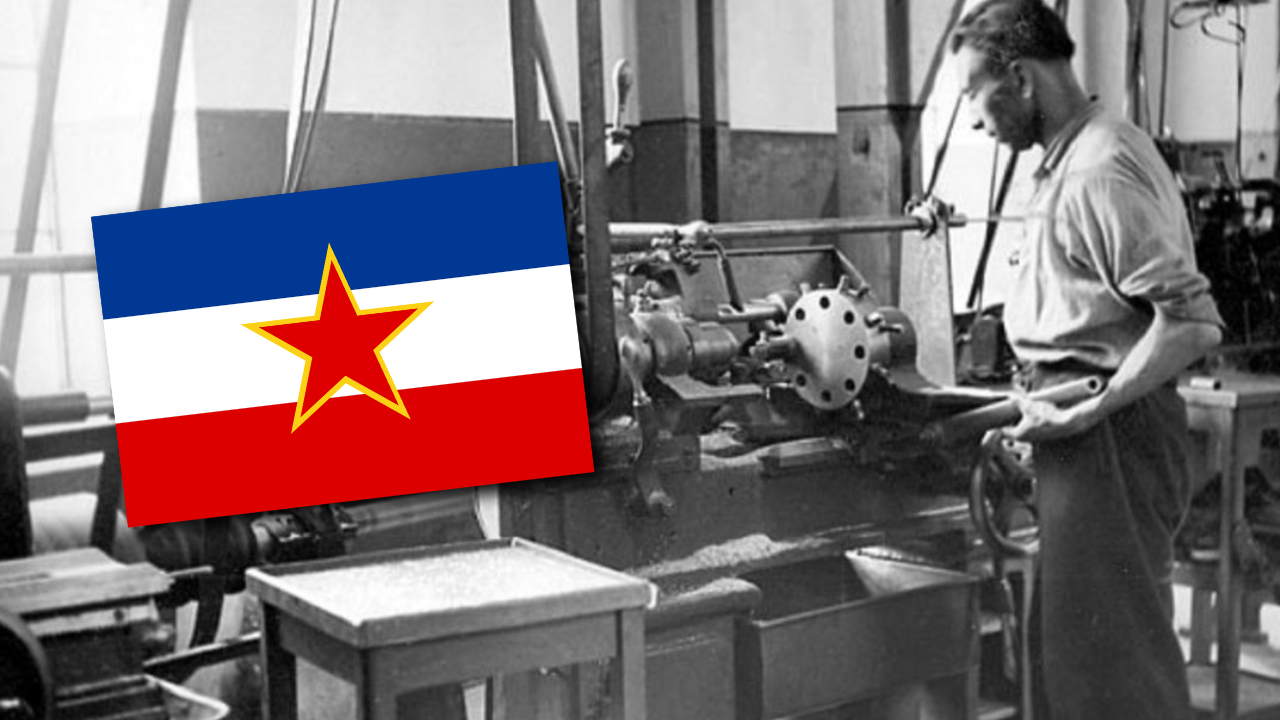
When discussing the former Socialist Federal Republic of Yugoslavia, industry is often cited as one of the key pillars of the country’s development and independence. From steel mills to aircraft manufacturers, Yugoslavia possessed powerful factories that employed tens of thousands of workers, exported goods worldwide, and stood as symbols of technological progress within the system of socialist self-management. Today, many of these industrial giants no longer exist, but their legacy remains deeply embedded in the collective memory of the region.
Below, we present the most powerful factories of former Yugoslavia, those that dominated their markets, led in innovation, and left an indelible mark on history.
1. Đuro Đaković – Slavonski Brod (Croatia)
An Industrial Giant of Strategic Importance
Founded in 1921, the Đuro Đaković factory was one of the most important centers of industrialization in the Yugoslav region. What began as a small railway workshop evolved into a multi-sector industrial conglomerate, particularly renowned for the production of armored vehicles, tanks, railway wagons, bridges, boilers, and heavy machinery.
During the SFRY period, Đuro Đaković became a strategic pillar of the military and heavy-industry sectors. Its production included:
- The M-84 tank, a modernized version of the Soviet T-72, exported to countries such as Kuwait
- Armored personnel carriers and combat vehicles used by the Yugoslav People’s Army and sold to foreign clients
- Industrial equipment for the energy and mining sectors
The factory had its own R&D facilities, testing centers, and state-of-the-art technology for its time. At its peak, it employed around 12,000 people and was one of Yugoslavia’s largest exporters of heavy equipment.
In addition to military production, Đuro Đaković manufactured infrastructure components such as bridges, cranes, turbines, and various specialized steel structures.
Today, the company still exists in a fragmented form, with significantly reduced capacity, but continues to strive to preserve its industrial tradition and rebuild its reputation in the defense and railway equipment sectors.
2. Zastava – Kragujevac (Serbia)
The Automotive Pride of Yugoslavia
Zastava was more than a factory. It was a national symbol of modernization, industrial development, and technological sovereignty. Founded in 1853 as a Military Technical Institute for the needs of the Principality of Serbia, it evolved over decades into one of the most important industrial systems in Yugoslavia.
Zastava entered automobile manufacturing in 1953 after signing a licensing agreement with the Italian company FIAT. Its first vehicle, the Zastava 600, was a domestic version of the legendary Fiat 600 and marked the birth of Yugoslav automotive production. Popular models soon followed:
- Zastava 750 (“Fića”), which became the people’s car
- Zastava 101 (“Stojadin”), a domestically designed family car produced in over 1.2 million units
- Yugo (Zastava Koral), exported even to the United States, where it achieved cult status despite criticism
During its golden years in the late 1970s and 1980s, Zastava produced over 230,000 cars annually and employed more than 50,000 workers, including those in satellite plants across Yugoslavia.
3. Torpedo – Rijeka (Croatia)
The Birthplace of the Modern Torpedo
Rijeka holds a proud place in global military history as the birthplace of the first modern torpedo. Founded in 1875, the Torpedo factory was originally part of the Austro-Hungarian military complex and later became a key industrial asset of Yugoslavia.
During the SFRY era, Torpedo produced military and civilian engines, marine equipment, heavy diesel generators, and torpedoes for the navy, while also developing industrial and railway engines.
At its peak, Torpedo:
- Employed around 5,000 workers
- Operated its own development facilities and foundry
- Exported extensively to the Middle East and Africa
The factory developed complex guidance and detonation systems for underwater weapons, making it one of the most technologically advanced military manufacturers in the region.
It also produced locomotive engines, ship propulsion systems, diesel generators for power utilities, and was among the pioneers of gas turbine development in Yugoslavia.
Following the breakup of Yugoslavia and changing market conditions, production gradually ceased, and much of the factory site was repurposed. Nevertheless, Torpedo’s historical legacy remains deeply ingrained in Rijeka’s identity and Europe’s technical heritage.
4. Prva Petoletka – Trstenik (Serbia)
Engineering Powerhouse
Founded in 1949, Prva Petoletka was a jewel of Yugoslav heavy and high-technology industry. Named after the country’s first five-year economic plan, the company specialized in hydraulic and pneumatic equipment, pumps, valves, and systems for energy, mining, transportation, and defense.
At its height, Prva Petoletka employed over 25,000 people and exported to more than 70 countries worldwide. It was a major supplier to the USSR, India, Egypt, China, and Western Europe. Its components were used in:
- Soviet railways and power plants
- India’s space program (hydraulic components for launch systems)
- Ships and tankers built in Yugoslavia
- Hydropower plants and industrial facilities throughout the Middle East
The company was highly innovative, with its own research institute, training system, and a specialized technical college in Trstenik. It was a pioneer of digital machine control in the late 1980s.
More than 60% of its output was exported, an exceptional figure even by the standards of the time.
Today, Prva Petoletka still exists, albeit with significantly reduced capacity and partially restored production, fighting to regain ground in markets it once dominated.
5. Gorenje – Velenje (Slovenia)
A Yugoslav White-Goods Brand with a Successful Future
Gorenje is one of the few Yugoslav industrial success stories with a positive continuation and impressive transformation. Founded in 1950 in the village of the same name, the company relocated to Velenje, where it quickly became one of Eastern Europe’s leading household appliance manufacturers.
Initially producing agricultural machinery, Gorenje soon shifted to electric cookers, refrigerators, freezers, and washing machines. By the early 1970s, the brand was present in almost every Yugoslav household and on store shelves across Western Europe.
Between 1975 and 1990, Gorenje:
- Employed over 11,000 workers
- Exported more than 70% of its production
- Established sales and logistics networks in over 20 countries
Gorenje was a pioneer in industrial design, combining functionality with modern aesthetics through collaborations with Italian and German designers.
After the breakup of Yugoslavia, the company successfully privatized, digitalized, and modernized. Today, it operates within the Hisense Europe Group, retaining its brand identity, development centers, and headquarters in Slovenia, and continues as a global player.
6. Rade Končar – Zagreb (Croatia)
The Backbone of the Electrical Industry
Founded in 1946, Rade Končar was the cornerstone of Yugoslavia’s electrical industry, specializing in power-generation equipment, transformers, generators, electric motors, electric vehicles, and household appliances.
At its peak, the company encompassed over 100 plants and subsidiaries, employing around 25,000 people, and played a crucial role in the electrification of Yugoslavia, from transmission lines and substations to railway traction systems.
Key areas included:
- Trams and electric multiple units used in Zagreb, Belgrade, and Sarajevo
- High-power transformers and generators exported to over 40 countries
- Industrial automation and control systems
With its own research institutes and close cooperation with technical universities, Rade Končar was also an innovation leader, developing computer systems and CNC controllers; rare achievements in the region at the time.
Despite reduced capacity after the 1990s transition, parts of the company continue to operate successfully under the Končar Group, focusing on energy and railway systems, and remain among Croatia’s most important technological brands.
7. Litostroj – Ljubljana (Slovenia)
Where Hydropower Took Shape
Founded in 1947, Litostroj was Yugoslavia’s leading manufacturer of hydroelectric equipment, heavy castings, and metallurgical components. It specialized in large turbines, pumps, and generators, the core of many power systems at home and abroad.
Its turbines were installed not only in Yugoslav power plants (Đerdap, Perućica, Jablanica), but also worldwide—from Iraq and Algeria to Ethiopia, India, and China.
Litostroj maintained an exceptionally high level of engineering expertise, with its own research institute and close cooperation with universities in Ljubljana and Maribor. Its engineers even participated in power-plant modernization projects in the USSR.
Employing over 5,000 workers, many of them highly educated specialists, Litostroj symbolized Slovenian industrial strength.
Today, it operates as part of the international Litostroj Power group, continuing its tradition of innovation and export in hydropower engineering.
8. Energoinvest – Sarajevo (Bosnia and Herzegovina)
Yugoslavia’s “Siemens”
Energoinvest was arguably the most modern and ambitious engineering and export giant from Bosnia and Herzegovina, a company that combined technology, science, economics, and diplomacy.
Founded in 1951, it grew from a modest power-distribution company into a multinational engineering corporation active in over 60 countries, employing around 40,000 people at its peak.
Its core activities included:
- Design and construction of energy systems
- Production of electrical equipment, cables, transformers, and software
- Mining, gas infrastructure, and chemical industry projects
Energoinvest carried out major projects in Iraq, Algeria, Libya, Nigeria, Iran, Pakistan, and Mexico, often as the main contractor.
It also operated its own computing division, developing domestic computers and industrial automation software in the 1980s. Making it a technological leader even by European standards.
More than a manufacturer, Energoinvest symbolized Yugoslavia’s ability to export knowledge, not just products.
Today, the company still exists in a much smaller form, focused primarily on energy and infrastructure projects, but its reputation endures as proof that global-level engineering was possible even within a socialist economy.
That concludes our overview. If you enjoyed this content, follow our blog malamedija.rs for more stories from the former Yugoslavia.
You can also check out our YouTube channel “MALAMEDIJA”, where we regularly publish documentary content on politics, history, society, and the legacy of former Yugoslavia.
Thanks!