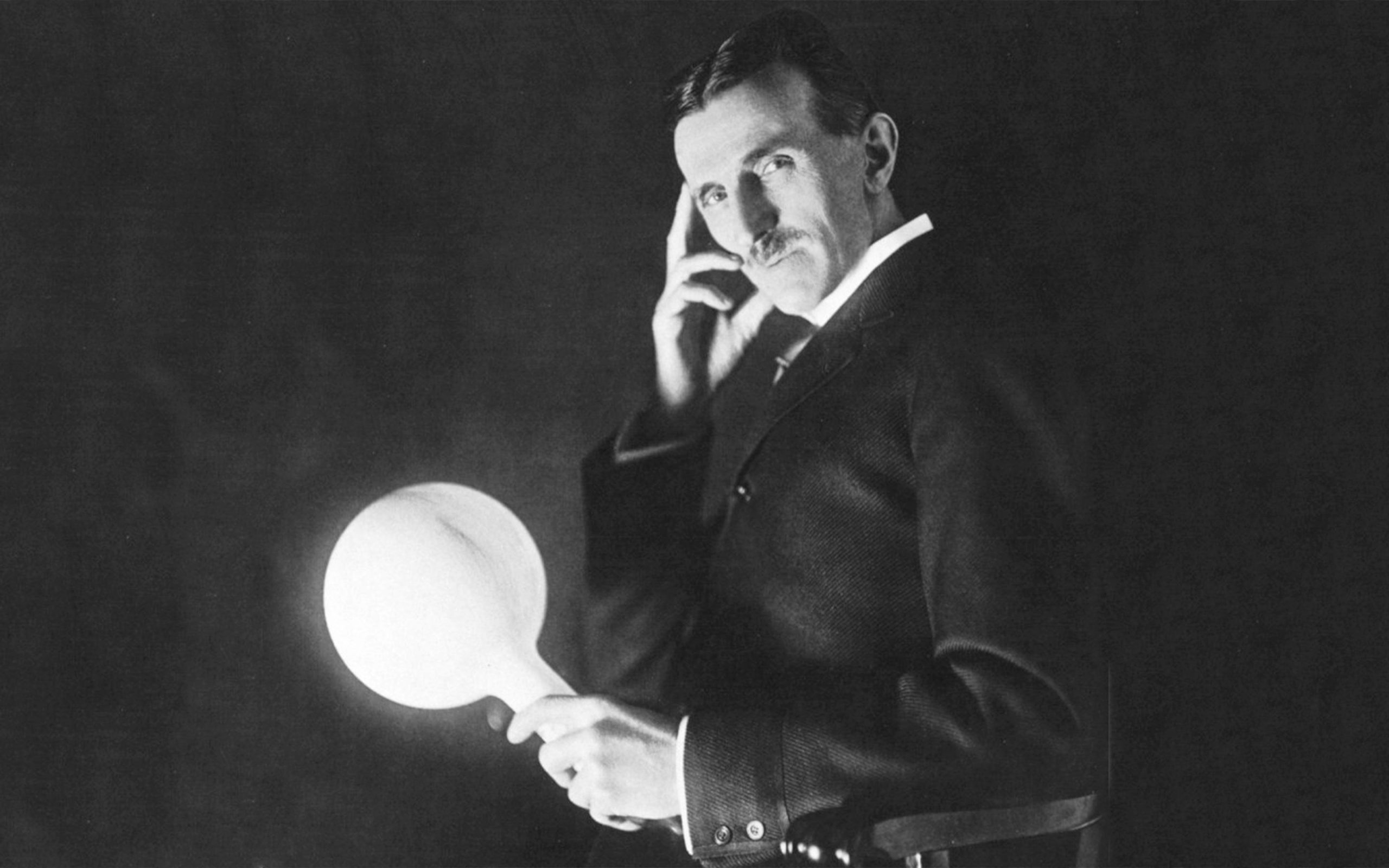
When it comes to Nikola Tesla, there is little need for excessive explanation. However, for those who may not be fully familiar with his legacy, Nikola Tesla was a brilliant scientist and inventor, best known for his revolutionary contributions to the fields of electricity and magnetism in the late nineteenth and early twentieth centuries. Below, we present some of his most astonishing inventions and ideas.
The Death Ray
Let us begin with what is perhaps Tesla’s most intriguing invention, or more precisely, a concept shrouded in mystery and controversy. Tesla claimed to have invented the so-called Death Ray, a powerful weapon capable of changing the very nature of warfare. It sounds unbelievable, and yet Tesla spoke of it with confidence.
According to his own statements, the Death Ray was a system designed to direct concentrated beams of particles or electromagnetic waves toward a target over vast distances. Allegedly, this weapon could destroy aircraft, vehicles, and even entire armies from a safe distance.
The concept of the Death Ray was first mentioned publicly in several newspapers in 1934, where Tesla was described as the man who had invented a deadly beam. Despite the sensational headlines, very little concrete evidence or technical documentation was ever left behind. No construction plans, operational manuals, or detailed descriptions of the device have survived.
Some historians of science believe that the Death Ray may have been Tesla’s attempt to attract attention and financial support for his other projects. Another interpretation suggests that Tesla used the idea to promote a vision of global defense, claiming that a weapon so powerful would deter all nations from engaging in war.
It is worth noting that Tesla was a pacifist, deeply shaken by the horrors of the First World War. In that context, his claims about the Death Ray are often seen as an effort to discourage future conflicts rather than encourage them.
On the other hand, conspiracy theorists argue that the Death Ray was real and that Tesla’s work was seized by government agents after his death. To this day, however, no credible evidence supports this theory. Whether real or imagined, Tesla’s Death Ray remains one of the most enduring and intriguing legends associated with his name.
Tesla’s Tower or the Wardenclyffe Tower
Among Tesla’s most ambitious projects was the Wardenclyffe Tower, also known as Tesla’s Tower. Construction began in 1901 on Long Island in New York, and the structure was intended to serve as a global wireless network for transmitting information and electrical energy.
Tesla envisioned a system that would provide free access to electricity for people around the world, along with long-distance wireless communication. His idea was based on using the Earth’s natural vibrations as a medium for energy transmission.
Unfortunately, financial difficulties prevented the project from being completed, and Tesla never succeeded in demonstrating the system as originally intended. Today, the site where the tower once stood has been transformed into a museum dedicated to his life and work.
Wireless Energy Transmission
One of Tesla’s most fascinating concepts was wireless energy transmission. He believed that electricity could be transmitted through the ground and the atmosphere without the use of wires or cables. Tesla built impressive experimental setups to demonstrate this principle.
Although he was unable to commercialize wireless power transmission over long distances, his research laid the groundwork for future developments in wireless communication and energy transfer technologies.
Tesla’s Flying Machine
While Nikola Tesla did not invent a flying saucer in the conventional sense, some of his ideas and patents contributed to theories surrounding unconventional aircraft. Tesla once stated that he had designed a flying machine that required neither wings nor propellers nor jet engines. Instead, it would be powered by an electrical system.
He described this aircraft as a machine that could draw energy from the Earth’s electromagnetic field. Like many of his revolutionary ideas, this project remained unfinished and surrounded by secrecy.
Together, the Wardenclyffe Tower and Tesla’s mysterious flying machine illustrate his visionary nature and relentless drive to create technologies capable of transforming the world. Even when his ideas remained theoretical, their influence endured.
Tesla’s Turbine
In the early twentieth century, Tesla worked on the development of a turbine as part of his efforts to improve methods of energy production and distribution. Inspired by his work on rotating electromagnetic fields, he explored how fluid dynamics could be used to generate power.
Tesla’s turbine was designed as an improvement over conventional steam turbines of the time. It had the potential to increase both efficiency and reliability in electricity generation.
The turbine operated using high-speed fluid flow to drive a rotating disk rather than traditional blades. One of its key advantages was the ability to function with various types of fluids, including water, steam, air, and gases. This made the device highly flexible and adaptable.
Thanks to its design, the turbine promised higher efficiency, reduced mechanical wear, and a longer operational lifespan compared to traditional turbines.
Alternating Current
One of Tesla’s most significant contributions to technology and arguably his greatest invention was the development of the alternating current system. At the time, most electrical systems relied on direct current, but Tesla recognized the advantages of alternating current.
His system allowed electricity to be transmitted more efficiently over long distances through the use of transformers. Thanks to Tesla’s innovations, alternating current became the foundation of modern electrical power systems worldwide.
Tesla’s Transformer and Magnifying Transmitter
Tesla’s transformer, often referred to as the Tesla Coil or Tesla Magnifying Transmitter, was a device capable of generating high-frequency currents and extremely high voltages. It amplified electrical oscillations and enabled the transmission of energy over considerable distances.
This invention played a crucial role in Tesla’s experiments with wireless energy transfer and the study of electromagnetic phenomena.
Radio Remote Control
Tesla also pioneered the development of remote control systems using radio waves. Through experiments with radio signals and oscillators, he successfully demonstrated the remote control of model boats and vehicles.
This concept later became the foundation for modern remote control technology, which is now an integral part of everyday life.
Electric Ignition for Gasoline Engines
During the early development of the automotive industry, one of the main challenges was creating a reliable ignition system for gasoline engines. Mechanical ignition systems were common but often unreliable and difficult to maintain.
Tesla recognized the need for a more advanced solution and invented an electric ignition system, known today as the spark plug for internal combustion engines. He received a patent for this invention under the title Electric Igniter for Gas Engines.
Designed in 1898, Tesla’s system enabled automatic ignition at the optimal moment during the engine cycle. This eliminated the need for manual adjustments and significantly improved engine performance, efficiency, and reliability. Tesla’s ignition system became a cornerstone of modern automotive technology.
These are just some of the remarkable inventions of this extraordinary scientist. Be sure to explore our other articles on malamedija.rs.
Thank you for reading,
your malamedija.rs